I have always been drawn to art…the creation of it and those who create it. I’ve attempted to create art in various mediums and it’s always so liberating and fulfilling. I believe anyone can create art, regardless of whether someone thinks they’re good at it. Sometimes art is personal, therapeutic, and healing.
I can’t remember how I first discovered Kusama’s artwork, but I immediately felt a strong connection. That feeling of connection grew as I read more about her life and the amazing contributions she’s made to the art world.
Join me in celebrating the enduring legacy of Yayoi Kusama, Princess of the Polka Dots.
Violet Voices

Yayoi Kusama, Flower Spirit, c.1948, oil on canvas, 37.7 × 45.6 cm. Copyright Yayoi Kusama. (Source)
The environment I grew up in was exceedingly conservative, and escaping it at the earliest possible moment had been my dream, and my struggle.
Yayoi Kusama was born in the rural city of Matsumoto, Nagano Prefecture, Japan, in 1929. She started experiencing aural and visual hallucinations at a young age. She remembers sitting in a bed of violets, each with a unique face and voice. At first, she was terrified of these experiences. However, as the episodes increased, she would draw what she had seen in her sketchbook. Recording these experiences helped ease the shock and fear. Psychiatry was not accepted in her youth so she kept her anxiety and hallucinations a secret. Painting was the thing that inspired her to keep living.
When Yayoi was a young girl, she would accompany her grandfather to a large seed harvesting ground. It seemed to her that pumpkins do not evoke feelings of respect. However, she is intrigued by their “charming and winsome” form. To this day, she is inspired by the “solid spiritual balance” and “unpretentiousness” of pumpkins.

Photograph: Tanisorn Vongsoontorn. Louis Vuitton x Yayoi Kusama Dancing Pumpkins (Source)
Her parent’s relationship was tumultuous. Whenever her father left to visit one of his mistresses, her mother would make her follow him, even in frigid weather. To make matters worse, her mother was vehemently opposed to her painting. According to her, painters in Japan led “poor, hopeless” lives. Despite her mother criticizing her hobby and kicking her canvases across the room, Yayoi persisted in painting. Her father, however, would support her painting and even purchase supplies for her.
In 1948 Yayoi enrolled in the Kyoto Municipal School of Arts and Crafts. Though it allowed her to escape the chaos of her family, the oppressive and hierarchical art world in Japan was stifling her creativity. She then decided she had to leave Japan as soon as possible.
Dreaming of the World Beyond

Yayoi & Zoe Dusanne (Source)
I used to wonder what lay beyond those daylight-swallowing mountains.
After the war ended, a then twenty-something Yayoi was browsing a second-hand bookshop, when she stumbled upon a Georgia O’Keefe book of paintings. She had heard from a friend that Georgia O’Keeffe was the most famous painter in the United States and decided to write her a letter.
After a six-hour train ride to Shinjuku, Yayoi visited the American Embassy and found Georgia O’Keeffe’s address. She wrote a letter when she got home, including several watercolor paintings. Much to her surprise, Georgia O’Keeffe wrote back! Yayoi was now even more determined to get to the United States. After contacting a distant relative, she found a sponsor and obtained a visa.
The first stop was Seattle, Washington. In December 1957, Yayoi had her solo show at the Dusanne Gallery. Twenty-six of her watercolors and pastels were featured. Much to her delight, the exhibition was a success! Despite those in Seattle wanting her to stay, Yayoi turned her sights to New York.
Escape to New York

In My Studio, New York, c. 1960 (Source)
Unable to sleep, I would get out of bed and paint. There was no other way to endure the cold and hunger.
The trip to New York was a turbulent one. Once the plane landed, Yayoi headed to the Buddist Society, a hostel for foreign students. She stayed for three months before moving into a loft. Unfortunately, the Vietnam War took its toll, and food prices increased drastically. Yayoi struggled to purchase canvas and paints, sometimes going an entire day without eating.
One day, she received a knock at the door. To her great surprise, Georgia O’Keeffe was standing in front of her. She was visiting New York and wanted to stop by and see how Yayoi was faring. Determined to help the impoverished Yayoi, Georgia introduced her to Edith Halpert, an art dealer.
After that, Yayoi painted non-stop. Most days she suffered from severe neurosis and would paint the same thing over and over. She was taken to the hospital during a panic attack and after a few visits, the staff told her that she needed psychiatric help. With anxiety “in her bones”, she kept painting like mad. She was determined to build her life as a successful artist.
Polka Dot Revolution
(Source)
I wanted to examine the single dot that was my own life. One polka dot: a single particle among billions.
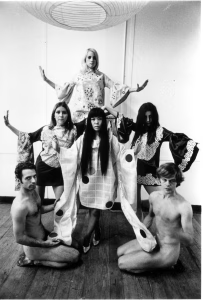
In 1967, the Hippie movement was in full swing and Yayoi had lived in America for a decade. It was during this time she experimented with performance art. Her fascination and hatred for sex which she had harbored since she was a child was one of her biggest inspirations for the “Kusama happenings”.
Polka Dots were the trademark of the happenings. During these performances, the volunteers would allow Yayoi to paint dots on them, whether half-clothed or nude. The dots could represent the earth, sun, or moon…defining them was not important. These performances gained Yayoi popularity and fans.
She was nicknamed “Queen of the Hippies” and became an icon in the LGBTQ+ community. They saw her studio as a haven to convene in and 200 individuals would participate in her happenings. Yayoi often received complaints and threats to her studio, and her bodyguards were always prepared for a violent outburst.
Global Happenings

Body Festival Poster, 1967, New York (Source)
Which do you think is worse, war or free sex? Do you prefer war?
In October 1967, Yayoi staged a performance at a solo exhibition in Amsterdam. The lights were shut off and bodies were covered in fluorescent paints. Some catcalled and Yayoi stopped and asked “Which do you think is worse, war or free sex? Do you prefer war?” The crowd fell silent. The next performance occurred in Delft, where Yayoi walked through the partially (or fully naked) individuals in the crowd and covered them in red, blue, and yellow polka dots.
In February of 1968, Yayoi organized an anti-war demonstration in New York called the Body Paint Festival for which she was arrested and put on trial. This didn’t stop her from planning for happenings from July – November of that year.
Yayoi decided to branch out into fashion, film, and music. In April of 1969, she opened a boutique at the corner of 6th Avenue and 8th Street in New York. The clothes she designed were, to no one’s surprise, covered in polka dots.
Returning to Japan

Yayoi Kusama, Infinity Net A, 1965, oil on canvas, 132 × 126 cm. Copyright Yayoi Kusama (Source)
My movement was distorted and misinterpreted by the Japanese media, who seemed interested only in exploiting me.
Thirteen years after escaping Japan at age twenty-seven, Yayoi returned to visit Japan. She braced for the media backlash and slander. Previously, members of the Japanese press visited her New York studio and wrote malicious things afterward. Unfortunately, her mother and father believed every word the Japanese media wrote about her. Yayoi did her best to come prepared with a lawyer, for advice and to make sure she could return to the United States. After living overseas for so long, she realized how oppressed the Japanese were.
On March 12, 1970, Yayoi appeared on the Nazu Kazu Morning Show, where a female anchor jokingly inquired about her choice of underwear. Yayoi replied, “Let me show you!” and removed her stockings. The assistant stepped in front of the camera to block the shot, while the cameraman tilted the camera to the ceiling. This solidified her beliefs about the reluctance of the Japanese to embrace their sexuality.
After two months, Yayoi grew tired of the same questions from the press and her lack of progress with the general public. To her, sex was a confirmation of love and equality. She soon shifted her happenings to Europe and in 1972, she returned to New York. That year she was also added to the American Who’s Who list, a biographical database.
Kindred Spirits

Yayoi with Joseph Cornell in New York, c. 1971. (Source)
You & me—birds of a feather.
Preserved in the Smithsonian American Art Museum’s Joseph Cornell Study Center, is a note sent to Cornell from Kusama that reads: “You & me—birds of a feather.” Taped beside these words are two feathers of sharply contrasting hue—one bright red, the other downy white—aptly standing in for this odd artistic couple, born twenty-six years and a hemisphere apart (Kaplan, 2021).
Yayoi met Joseph Cornell in 1962 while accompanying an art dealer to his home. She told her that he was “eccentric and reclusive” and that he cared for his aging mother and little brother who had cerebral palsy. In 1931, he was inspired to create art after seeing the work of Max Ernst, a Surrealist.
Unbeknownst to Yayoi, they had both participated in a show at the Gertrude Stein Gallery in New York. When he saw Yayoi he turned to the art dealer and said, “I really must thank you for introducing me to such a lovely person”. His workroom was a mess…crates, and boxes were strewn about accompanied by stacks of magazines. His art was based on mundane objects, inviting the viewer to embrace the endearing charm of collage.

Self Obliteration (1967) (Source)
Soon after they met, Joesph began writing poems to establish a relationship between himself and Yayoi. He would call her multiple times a day and wanted to chat for hours. This caused her to be unreachable by colleges and art dealers. Though this annoyed Yayoi, there was something undeniably intriguing about Joesph, and according to her, his art was fantastic.
He lived with his aging mother, who Yayoi didn’t get along with. His mother despised any woman who got “too close” to Joesph. It was a strange relationship…she would scream at him for kissing Yayoi, even if they were only holding hands. Yayoi told Joesph that she hated being treated so poorly by his mother and debated separating but he pled with her to reconsider.
Part of her pitied him, he had no friends and was tremendously lonely. Yayoi believes their love was spiritual, a “pure and sacred kind of bond”. Though their relationship lasted over a decade, they never consummated it.
Worldwide Kusamania
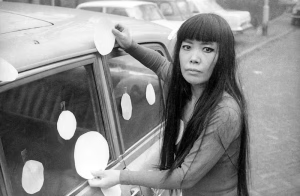
Artist Yayoi Kusama next to her “Dot Car” (1965). Photo credit: Harrie Verstappen (Source)
I veered violently between two extremes: the sense of fulfillment an artist gets from creating, and the fierce inner tension that fuels creativity.
Yayoi lived in New York for sixteen years. She had successfully created her future and started a revolution. Underneath her grandiose goals, she wanted nothing more than to heal herself from the traumas of her childhood and psychosomatic illness.
Unfortunately, in 1973, her health began to deteriorate. She returned to Japan for what she thought would be a temporary stay and left her apartment full of possessions. During her stay, the hallucinations became more frequent, and in 1975, she checked into a hospital in Shinjuku.
Yayoi was disappointed that Japan was still as conservative as ever and was now devoid of individuality. She recalls that Japan had grown “ugly as she modernized”. When returning to her hometown for the Oban Festival, she felt a wave of loneliness and lost time. Once winter came to Mastumoto, her spirits began to lift. The snowfall reminded her of happy childhood memories.
Rediscovering Japan
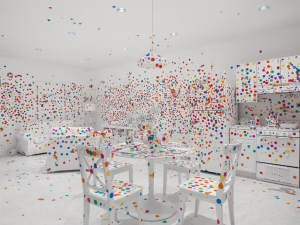
‘Obliteration Room’ by Yayoi Kusama. Courtesy of Dogwoof (Source)
Self-expression through art and writing are essentially the same thing. Both offer methods of discovering new territories of the mind.
The winter had a healing effect on Yayoi as she rediscovered the beauty of her hometown. Her friends and acquaintances soothed her soul and rejuvenated her spirit. Though she enjoyed this warmth and acceptance, she decided she did not want to stay there permanently.
The production of her work continued when she returned to an open ward in Tokyo, where she has remained ever since. Across the street from the hospital she built an art studio, where she works daily. Her schedule is now fixed: she wakes up for a blood test at 7 am, goes to work in her studio from 10 am to 7 pm, and retires at 9 pm.
In December 1975 Yayoi held her first solo show since returning to Japan titled, Message of Death from Hades at the Nishimura Gallery in Tokyo. She has experimented with collages, silk screens, and lithographs. She has also written several novels, novellas, and poems.
Art That Will Last Forever

(Source)
If you have managed, in the midst of a society awash with lies and madness, to get one step closer to the awe-inspiring brilliance of your own life, the footprint you leave behind is that of someone who has truly lived as a human being.
To this day, Yayoi feels like she hasn’t “made it” as an artist. She believes that an artist is not superior to others just because they create art. She considers herself an aspiring artist who strives to search for and emulate truth.
She has held numerous exhibitions of new works at museums, galleries, and art fairs worldwide. In 2001, she received the prestigious Asahi Prize from the Newspaper Foundation for Education and Culture. During the past several years, Yayoi has received invitations from museums overseas to hold solo exhibitions. She is always enthusiastic about participating and constantly comes up with new ideas.
Yayoi cherishes each day and sees the present as the best time of her life. Though she has created a significant amount of artwork in recent years, she acknowledges that she is always fatigued. Walking at least 1,000 steps daily is a priority for Yayoi, to maintain her health. Despite her lifelong hardships and how she sometimes suffers for her art, she has no regrets.
Recent Exhibitions
For those new to Yayoi Kusama’s art, I encourage you to explore and form a deeper understanding of her eccentric and wonderful pieces.

Pérez Art Museum Miami – LOVE IS CALLING
Miami, Florida (March 2023 – April 2024)

David Zwirner Gallery – I Spend Each Day Embracing Flowers
New York, New York (May – July 2023)

Memorial Art Gallery – Infinity Mirrored Room – Let’s Survive Together
Rochester, New York (September 2023 – May 2024)
Sources
Kaplan, H. (2021, October 15). When Kusama Met Cornell: The exhibition Artist to Artist shines a light on important artistic friendships. Smithsonian American Art Museum. https://americanart.si.edu/blog/kusama-cornell-art
Kusama, Y. (2021). Infinity Net: The Autobiography of Yayoi Kusama. Tate Enterprises Ltd. https://books.google.com/books?id=MhZ-AwAAQBAJ&source=gbs_navlinks_s